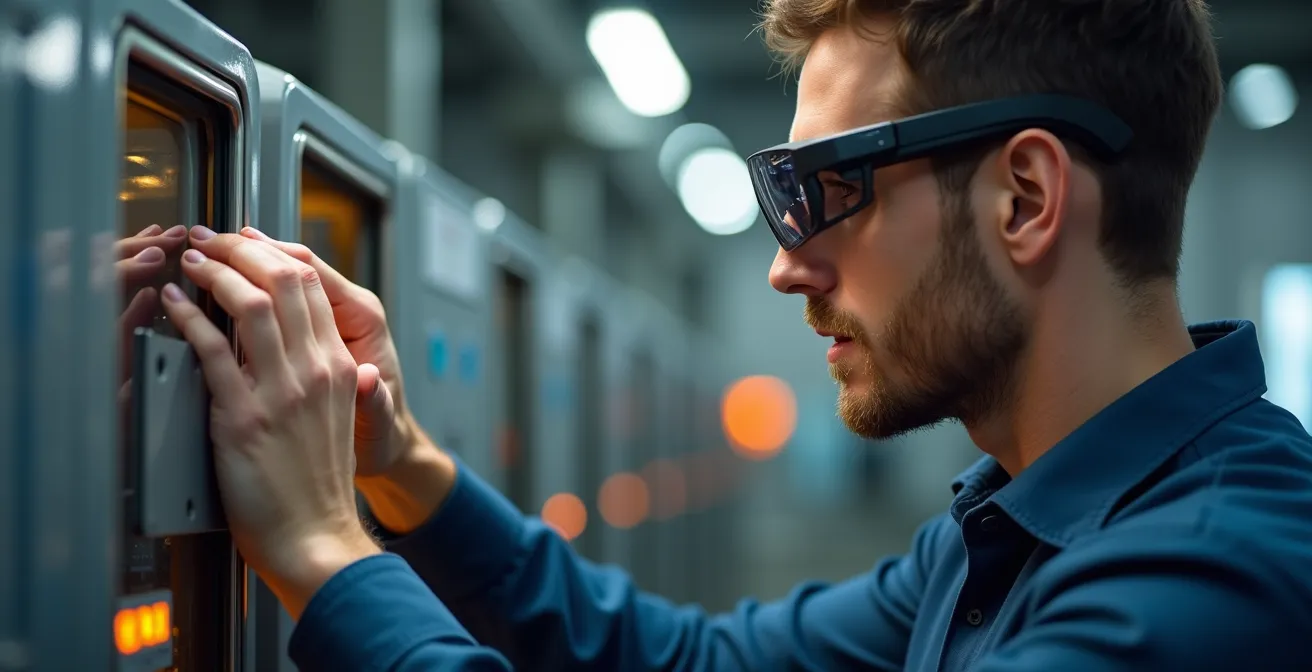
Implementing smart glasses can slash new hire time-to-competency by up to 50% by fundamentally re-architecting their cognitive workflow, not just providing digital instructions.
- This technology transforms training from a passive event into a source of active, measurable performance telemetry.
- Success hinges on choosing hardware based on Total Cost of Ownership (TCO) and planning a structured pilot program with clear KPIs.
Recommendation: Instead of a full-scale deployment, initiate a 90-day pilot on a single high-visibility production line to quantify ROI and build an internal business case.
The persistent skills gap in manufacturing creates a critical bottleneck. Traditional training methods—shadowing senior technicians, studying dense manuals, and trial-and-error on the line—are slow, inconsistent, and introduce significant risks of production errors and safety incidents. The core challenge isn’t just a lack of knowledge, but the inefficiency in transferring complex, procedural skills from an expert’s mind to a novice’s hands. This leads to extended downtime, quality control failures, and a frustratingly long time-to-competency for new staff.
Many facilities have explored digital work instructions on tablets or stationary screens, but these solutions often fail to deliver transformative results. They still require the operator to divide their attention, looking away from the task to consult a screen, which breaks concentration and can be impractical or unsafe in many industrial environments. These methods digitize the old process but don’t fundamentally change the cognitive load placed on the worker.
But what if the solution wasn’t just about accessing information, but about integrating it directly into the operator’s field of view? The true potential of wearable technology lies in its ability to re-architect the cognitive workflow of your staff. By using smart glasses, you don’t just give them a manual; you provide a real-time, context-aware layer of data that guides their hands and eyes, accelerating the development of procedural memory. This approach transforms training from a qualitative, observation-based process into a quantifiable, data-driven system focused on a single metric: performance.
This article will deconstruct the strategic implementation of smart glasses for industrial training. We will move beyond the surface-level benefits to explore the mechanics of cognitive load reduction, the critical path for system integration, the financial models for hardware selection, and a roadmap for deploying this technology to achieve a measurable 50% reduction in training time.
This in-depth guide provides a strategic framework for plant managers and directors. The following sections break down the critical components of a successful AR training implementation, from initial justification to full-scale deployment strategy.
Summary: How to Use Smart Glasses to Train Manufacturing Staff 50% Faster?
- Why Hands-Free Devices Reduce Accidents During Heavy Machinery Training?
- How to Sync VR Headset Data With Your Legacy HR System?
- Oculus or HoloLens: Which Hardware ROI Justifies the Expense?
- The Sanitation Oversight That Spreads Illness Through Shared Headsets
- When to Introduce Wearables: Pilot Program or Full Deployment?
- Why Spending $50k on a VR Module Is Cheaper Than One Real-Life Accident?
- Why Reading Documentation Is Not Enough to Learn a New API?
- How to Train Surgeons or Pilots Risk-Free With Virtual Reality?
Why Hands-Free Devices Reduce Accidents During Heavy Machinery Training?
The primary driver behind accident reduction in AR-assisted training is the drastic decrease in cognitive load. A trainee operating heavy machinery without guidance is performing constant mental juggling: recalling instructions from a manual, visually scanning for the correct lever or button, and physically executing the action. This split attention is a major source of error. An AR headset eliminates this by overlaying instructions directly onto the equipment. The trainee’s eyes remain on the task, their hands are free, and the next step is always in their field of view. This creates a single, unified cognitive workflow.
This streamlined process not only reduces mistakes but actively builds correct procedural memory faster. By seeing and doing simultaneously, the brain forges stronger neural pathways than by reading and then attempting to recall. This is particularly crucial during high-stress or complex procedures where the risk of error is highest. The reduction in mental effort frees up cognitive resources for better situational awareness, allowing the trainee to notice environmental hazards they might otherwise miss. The result is not just a safer trainee, but a more competent one, faster.
The efficiency gains are quantifiable. By removing the need to stop and consult external documentation, the training process becomes fluid and continuous. Industry studies have demonstrated this effect, with some showing 30-40% faster training efficiency with AR glasses compared to traditional methods. This acceleration directly translates to fewer hours of supervised training required and a quicker path to productive, safe operation on the factory floor.
How to Sync VR Headset Data With Your Legacy HR System?
Integrating AR/VR training data into your Human Resources Information System (HRIS) is the critical step that transforms wearable devices from a simple training tool into a strategic talent management asset. Without this link, valuable performance telemetry—such as task completion times, error rates, and procedural deviations—remains siloed in the AR platform. Syncing this data allows you to automatically update training records, certify competencies, and identify skill gaps at an individual and team level, all within your existing HR framework.
This synchronization is not a one-size-fits-all process. The optimal method depends on your current IT infrastructure, the scalability required, and the specific data you need to track. The primary options range from using middleware solutions with pre-built connectors for major systems like SAP or Oracle, to leveraging cloud-based Integration Platform as a Service (iPaaS) for greater flexibility, or developing custom APIs for full control over data flow. Enterprise-grade AR platforms often include their own integration tools, simplifying the process but potentially creating vendor lock-in.
The strategic selection of an integration method is paramount for long-term success. It determines how seamlessly training achievements translate into official employee records and career development paths. The goal is to create a closed-loop system where on-the-floor performance, captured via headset, directly informs workforce management strategy.

Major enterprises are already proving the value of this integrated approach. For instance, Boeing has successfully implemented AR glasses in their wire assembly process. This integration not only guides technicians but also captures performance data, helping them achieve a significant reduction in errors and cut production time by up to 25%. This demonstrates how a well-integrated system moves beyond training to directly impact core production metrics.
The following table, based on common industry offerings, compares the main approaches for integrating AR/VR data with legacy HR systems, providing a decision-making framework for IT and operations leaders.
| Integration Method | Compatibility | Key Features | Implementation Time |
|---|---|---|---|
| Middleware Solutions | SAP, Oracle, Workday | Pre-built connectors, minimal coding | 2-4 weeks |
| iPaaS Platforms | Most legacy systems | Cloud-based, scalable, API management | 3-6 weeks |
| Custom APIs | Any system | Full customization, complex metrics | 2-3 months |
| Enterprise AR Platforms | Major HRIS systems | Built-in analytics, compliance tools | 4-8 weeks |
Oculus or HoloLens: Which Hardware ROI Justifies the Expense?
The choice of hardware is a critical investment decision, governed by the specific use case and a rigorous analysis of Total Cost of Ownership (TCO), not just the initial purchase price. The market is broadly divided into Virtual Reality (VR) like the Meta Quest series and Augmented/Mixed Reality (AR/MR) like the Microsoft HoloLens or RealWear Navigator. VR is ideal for fully immersive, off-the-floor simulations where trainees can learn in a completely virtual, risk-free environment. AR/MR, conversely, is designed for on-the-job guidance, overlaying digital information onto the real world, making it perfect for complex assembly or maintenance tasks.
For a Plant Manager, the justification for the higher cost of enterprise-grade MR devices like the HoloLens 2 comes down to direct operational impact. These devices are built for industrial environments, offer robust enterprise support, and enable use cases like remote assistance that have a clear and immediate ROI. For example, some manufacturers report average savings of $30 per labor hour with HoloLens 2 implementation, driven by reduced errors, faster task completion, and decreased need for expert travel.
Calculating the Return on Investment (ROI) requires looking beyond the hardware. TCO includes software licensing, platform integration costs, content development, IT support, and device management. While a VR headset may seem cheaper upfront, the cost of creating a high-fidelity digital twin of your machinery for a simulation can be substantial. Conversely, an AR device might be more expensive, but the content (e.g., step-by-step instructions) may be simpler to author and deploy.
The decision matrix should align the device’s capabilities with your primary training objective. If the goal is to teach complex, hands-on assembly procedures on the actual production line, a hands-free, see-through AR device is superior. If the goal is to train for rare, high-consequence emergency scenarios, an immersive VR simulation is the more effective and safer choice.
This comparative table provides a high-level analysis of TCO and primary use cases for leading enterprise-grade hardware categories, helping to frame the financial decision.
| Device Category | Initial Cost | Annual TCO | Best Use Cases | Enterprise Support |
|---|---|---|---|---|
| Meta Quest (VR) | $500-1,500 | $2,000-4,000 | Immersive training simulations | Growing ecosystem |
| HoloLens 2 (MR) | $3,500-4,500 | $5,000-8,000 | Complex assembly, remote assistance | Microsoft enterprise grade |
| RealWear Navigator (AR) | $1,500-2,500 | $2,500-4,500 | Hands-free industrial operations | Ruggedized, ATEX certified |
| Vuzix M400 (AR) | $1,000-1,800 | $2,000-3,500 | Light assembly, quality control | Lightweight, long shifts |
The Sanitation Oversight That Spreads Illness Through Shared Headsets
While the focus of AR implementation is often on software and ROI, a critical operational oversight can derail the entire program: headset sanitation. In a manufacturing environment where devices are shared across shifts by multiple users, improper hygiene protocols pose a significant risk of spreading bacteria, viruses, and skin conditions like contact dermatitis. This is not just a health and safety issue; it directly impacts user adoption. A device that is perceived as unhygienic will be met with resistance from staff, undermining your investment.
Effective sanitation goes beyond a simple wipe-down with an alcohol-based solution, which can damage optical coatings and foam padding. A robust protocol requires a multi-faceted approach. This includes using medical-grade UV-C sanitation cabinets that can sterilize multiple devices simultaneously, providing disposable hygiene covers (such as face pads and head straps), and establishing a formal check-in/check-out procedure where sanitation is a mandatory step. The process itself must be as streamlined as the technology it supports.
The mindset for managing this should be borrowed from cleanroom and high-tech assembly environments. For example, Delta ModTech re-architected their machinery wiring to be modular, simplifying service and maintenance. This same philosophy of process-driven modularity can be applied to headset management. By implementing systematic procedures with integrated charging and sanitation cycles, the process becomes routine and reliable. This approach treats the headset not as a simple tool, but as a piece of personal protective equipment (PPE) that requires strict handling protocols.
Ignoring this aspect can lead to increased employee absenteeism due to illness and create potential liability issues. A well-defined and rigorously enforced sanitation protocol is a non-negotiable component of any shared-device program. It is a small operational detail with major strategic implications for the success and sustainability of your AR training initiative.
When to Introduce Wearables: Pilot Program or Full Deployment?
The temptation to pursue a large-scale, factory-wide deployment of AR technology is high, but the most successful implementations begin with a strategic, contained pilot program. A full deployment is capital-intensive and carries significant risk; if the initial use case is poorly chosen or user adoption falters, the entire initiative can be perceived as a failure. A pilot program, in contrast, allows you to test the technology, quantify its impact on a smaller scale, and build a data-driven business case for expansion.
The key to a successful pilot is selecting the right “lighthouse” project. This should be a high-visibility process with clear, measurable baseline metrics (e.g., assembly time, error rate, first-pass yield) and a team of motivated early adopters. The goal is to generate a clear, undeniable win that can be showcased to senior leadership and other departments. Companies like PBC Linear have used this approach to capture decades of specialist knowledge from veteran machinists and author it into AR instructions, creating on-demand expertise for newer staff.
A pilot program is not an informal trial; it must be a structured experiment with predefined success criteria. Before launch, you must establish the Key Performance Indicators (KPIs) you will track and the target improvements you need to see to justify a wider rollout. This requires documenting baseline performance for at least 30-60 days pre-implementation to ensure you have a reliable point of comparison.
The pilot phase is also your opportunity to refine content, troubleshoot technical issues, and gather critical user feedback. This iterative process ensures that when you do scale, you are deploying a proven solution, not an unverified concept. A well-executed 90-day pilot provides the hard data needed for a confident “Go/No-Go” decision and a roadmap for a successful, factory-wide implementation.
Your Action Plan for a Successful AR Pilot Program
- Define quantifiable KPIs: Set clear targets for task completion time, error rate reduction, and user satisfaction scores before the pilot begins.
- Select a ‘lighthouse’ project: Choose a high-visibility department or production line with motivated early adopters and clear baseline metrics.
- Document baseline performance: Collect and validate performance data for 30-60 days prior to implementation to create a reliable benchmark for comparison.
- Run a structured 90-day pilot: Implement the technology while conducting weekly performance tracking and formal user feedback sessions to identify issues and opportunities.
- Create a data-driven decision matrix: Use the predefined KPI thresholds to make an objective Go/No-Go decision for a wider rollout based on demonstrated ROI.
Why Spending $50k on a VR Module Is Cheaper Than One Real-Life Accident?
The direct and indirect costs of a single workplace accident in a manufacturing setting can be astronomical, often reaching hundreds of thousands or even millions of dollars. These costs extend far beyond immediate medical expenses and insurance premium hikes. They include production downtime, equipment damage, regulatory fines from bodies like OSHA, legal fees, and the long-term impact on employee morale and company reputation. When viewed through this lens, a $50,000 investment in a VR training module for a high-risk task is not an expense; it’s a high-ROI insurance policy.
VR allows trainees to experience and learn from failure in a completely safe, virtual environment. A new hire can “crash” a virtual forklift or incorrectly sequence a lockout-tagout procedure with zero real-world consequences. This “safe failure” is one of the most powerful learning tools, building a deep understanding of consequences that a classroom lecture or manual can never replicate. The investment in VR directly mitigates the financial risk associated with the most expensive part of the learning curve: the first major mistake.
This approach is particularly effective for high-complexity tasks where both the risk and the training time are significant. For example, AR-based instruction demonstrates a 14.94% time savings in high-complexity assembly training, reducing the exposure time for novices on the floor. This principle is exemplified by companies like TK Elevator, which uses MR to train maintenance crews on complex elevator repairs. This investment has led to a significant reduction in safety incidents and their associated cascading costs, proving the financial viability of a proactive, technology-driven safety strategy.
Ultimately, the calculation is simple. You can either budget for the predictable, one-time cost of a VR training module or face the unpredictable, open-ended, and potentially catastrophic cost of a real-life accident. For any high-stakes manufacturing process, the former is the only fiscally responsible choice.
Why Reading Documentation Is Not Enough to Learn a New API?
Relying solely on static documentation—whether it’s a PDF manual for a machine or API documentation for a software system—is an inherently flawed training method. Documentation can effectively teach the “what”—the names of components, the functions of buttons, the parameters of a command. However, it fundamentally fails to teach the “grammar” of the task: the correct sequence, the precise timing, and the complex interdependencies between actions. This gap between theoretical knowledge and practical application is where most errors occur.
Procedural tasks are learned through doing, which builds muscle memory and an intuitive understanding of the process flow. Reading a 200-page manual does not prepare a technician for the feel of a correctly torqued bolt or the sound of a machine operating within normal parameters. This is where AR training creates a paradigm shift. It bridges the gap by overlaying the “grammar” directly onto the physical world, guiding the user through the process step-by-step in real time.
As one comprehensive study on the subject notes, this limitation is universal in traditional training methods. The following insight highlights the core issue:
The static manual teaches the ‘what’ but fails to teach the ‘grammar’—the sequence, timing, and interdependencies
– Manufacturing AR Implementation Study, Advanced Manufacturing AR Training Research
AR transforms this passive learning into an active, kinesthetic experience. Instead of reading about a process, the trainee performs it with real-time feedback. This can involve:
- Interacting with 3D models of internal components overlaid on the actual machinery.
- Experiencing ‘safe failure’ modes where a wrong step triggers a virtual consequence.
- Building procedural memory through repeated, AR-guided physical movements, not just reading.
- Using gaze tracking to identify where a user is hesitating, indicating a comprehension gap.
This interactive method accelerates the transition from conscious, step-by-step execution to subconscious, expert fluency.
Key Takeaways
- AR/VR training accelerates time-to-competency by reducing the user’s cognitive load, not just by providing information.
- Successful implementation requires a structured pilot program focused on a ‘lighthouse’ project with clear, pre-defined KPIs and ROI targets.
- Hardware selection must be driven by Total Cost of Ownership (TCO) and the specific use case (immersive VR simulation vs. on-the-job AR guidance).
How to Train Surgeons or Pilots Risk-Free With Virtual Reality?
The principles that make AR/VR training revolutionary in manufacturing are directly borrowed from the playbooks of other high-stakes industries like aviation and surgery. For decades, pilots have trained in multi-million dollar flight simulators, allowing them to master emergency procedures in a zero-risk environment. Similarly, surgeons are increasingly using VR to practice complex operations, refining their motor skills and procedural knowledge before ever touching a patient. These fields recognized early on that for tasks where mistakes have catastrophic consequences, “learning on the job” is not an option.
The core methodology is transferable: de-risk the training process by decoupling it from the live operational environment. The aerospace industry uses this for critical maintenance tasks. As seen in aircraft maintenance applications, engineers use HoloLens 2 to interact with holographic overlays of schematics while working on complex systems. This ensures they perform tasks correctly and allows them to connect with remote experts in real-time for critical support, blending the virtual and physical worlds to eliminate errors.
The results in these sectors are compelling and provide a benchmark for manufacturing. In some cases, manufacturers have achieved a 75% reduction in training time by adopting mixed reality systems, mirroring the efficiency gains long seen in aviation. This proves that the investment in creating high-fidelity virtual training environments yields a massive return in both speed and safety.
For a Plant Manager, this cross-industry validation is crucial. It demonstrates that AR/VR is not a speculative technology but a proven methodology for accelerating expertise in complex, high-stakes domains. The factory floor is no different from a cockpit or an operating room: it is an environment where precision, procedural accuracy, and safety are paramount. By adopting the same training philosophy, manufacturing can achieve similar transformative results in performance and safety.
To begin leveraging this technology, the next logical step is to identify a single, high-impact process within your facility and design a structured pilot program to quantify the potential ROI. Start small, prove the value with hard metrics, and build a scalable foundation for a more competent, efficient, and safer workforce.